

Industrial facilities often handle oils, coolants, wastewater, and process fluids that contain various forms of contamination. Choosing between oil centrifuges and waste oil separators depends on the type of contamination, the required filtration level, and whether the fluid is being reused, recycled, or disposed of.
Waste oil separators are commonly used for oil-water separation and bulk contaminant removal. Oil centrifuges are better suited to fine solids, sludge, and some harder-to-separate contamination where gravity separation alone is not enough.
Oil Centrifuges and Waste Oil Separators Solve Different Problems
Waste oil separators remove free-floating oil and larger contaminants from wastewater or industrial fluids. These systems are commonly used in wash bays, workshops, transport depots, and manufacturing plants where oily wastewater needs treatment before discharge or recycling.
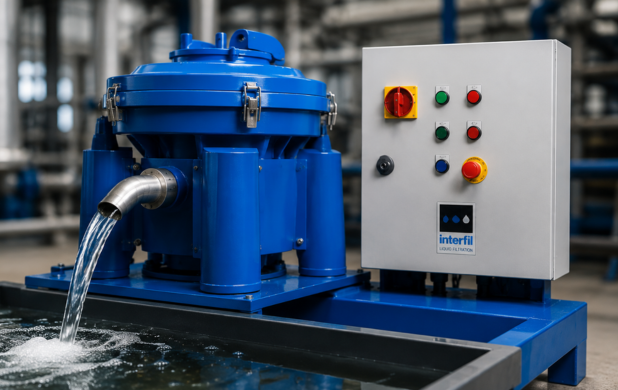
Oil centrifuges use high-speed centrifugal force to separate solids and liquids. Interfil’s centrifuge systems are used across wastewater treatment, industrial oils, emulsions, solvents, and liquid waste applications where contamination is finer or harder to remove.
Waste oil separators handle bulk oil separation, while centrifuges provide more precise contaminant removal.
Waste Oil Separators Work Best With Free Oil and Stable Wastewater Flows
Waste oil separators are generally suitable when oil is free-floating rather than tightly emulsified. These systems may use gravity separation, coalescing plates, skimmers, or filtration stages to separate oil from water.
They are often used where wastewater flow is steady and solids loading is moderate. In maintenance facilities, manufacturing plants, and industrial washdown areas, waste oil separators help reduce oil contamination before wastewater enters additional treatment stages.
Facilities managing oily wastewater streams often combine separation systems with wastewater filtration products to improve downstream treatment efficiency.
Waste oil separators are commonly selected because they can operate continuously without complex mechanical systems. In facilities processing large volumes of oily water every day, a simpler separation process can reduce servicing requirements and minimise operational interruptions.
These systems are generally most effective where oil contamination is visible, easier to separate, and not heavily mixed into the fluid.
Oil Centrifuges Are Better for Fine Solids and Emulsions
Oil centrifuges are more effective when contamination includes fine suspended solids, sludge, emulsified water, or microscopic metal particles.
A centrifuge spins fluid at high speed, forcing denser contaminants away from the cleaner liquid. This stronger separation force allows finer contaminants to be removed more effectively than standard gravity-based systems.
In manufacturing and metalworking environments, coolant systems often contain fine metal fines that standard separators cannot fully remove. Centrifuge systems help extend coolant life and reduce wear on pumps and machining equipment.
Facilities requiring finer solids removal often integrate centrifuge systems into broader fluid recovery and filtration processes.
Oil centrifuges are commonly used where fluid replacement costs are high or where oil cleanliness directly affects equipment reliability. In mining, drilling, and heavy industrial applications, fine solids can shorten fluid life and accelerate wear on critical components.
By removing smaller particles more effectively, centrifuge systems help maintain fluid performance for longer operating periods and support more consistent machinery operation.
The Type of Contamination Should Guide the Choice
Use waste oil separators when the main problem is free oil in wastewater. Use oil centrifuges when contamination contains fine solids, sludge, or emulsified material suspended throughout the fluid.
For example, oily runoff from a workshop wash bay may be suited to a waste oil separator because the oil separates relatively easily. A coolant system filled with fine metal particles is more likely to require centrifuge-based separation.
Using the wrong system can lead to poor separation performance, higher maintenance, and unnecessary fluid disposal costs.
Maintenance Requirements Differ Between the Two Systems
Waste oil separators are generally easier to maintain because they contain fewer moving parts. Operators usually remove collected oil, monitor sludge accumulation, and service filtration components as needed.
Oil centrifuges require more active maintenance due to their high operating speeds. Bowls, seals, and rotating assemblies need regular inspection and cleaning, especially in high-solids environments.
However, centrifuges can significantly extend oil life in demanding industrial applications, thereby reducing long-term operating costs.
Various filtration media are also used to support solids capture and improve downstream fluid treatment performance.
Choosing the Right System Depends on Process Demands
Many industrial facilities use multiple filtration stages rather than relying on a single separation method. A waste oil separator may remove bulk oil contamination first, while a centrifuge handles finer solids later in the process.
This staged approach is often more effective because each system targets a different type of contamination. Removing larger oil contamination early can reduce the load placed on downstream filtration equipment and improve overall treatment efficiency.
Choosing between oil centrifuges and waste oil separators should start with understanding the fluid’s contamination profile. Waste oil separators are generally better suited for free oil and continuous wastewater treatment, while oil centrifuges are better suited for fine solids, sludge, emulsions, and high-precision fluid cleaning.
The best system depends on how the contamination behaves within the process, how clean the recovered fluid needs to be, and how much maintenance the facility can support over time.