

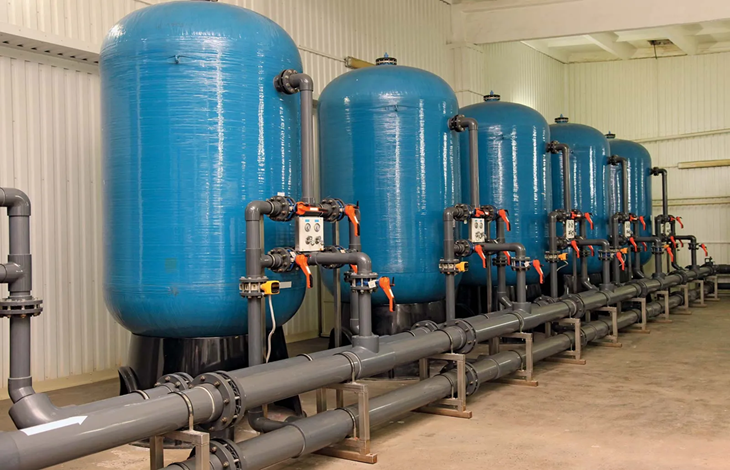
Metal finishing operations produce ferrous particles that pass through standard sand filters. Food processing generates organic solids that blind conventional media within hours, unlike metallic chips from precision cutting. The particle behaviour isn’t even close. Hence, getting liquid waste management right begins with contaminant identification. To operate effectively, you need to understand how blinding rates, particle loading, and bypass behaviour affect stability when choosing your wastewater filter media. Some contaminants won’t respond to granular filtration at all.
Wastewater filter media refers to the material used within filtration systems to capture suspended solids or remove contaminants from industrial wastewater before discharge or reuse.
Emulsified oils pass straight through sand or anthracite, so they require oleophilic cartridges instead. Production schedules also affect waste stream composition, so filtration media that performed well last quarter might struggle now if your product mix has changed.
Media Density
Multimedia filters work through density stratification. Anthracite (11-23 kg/m³) sits at the top, sand (45 kg/m³) in the middle, and garnet (57 kg/m³) at the bottom. Each material settles at different rates during backwash based on its density. Get the backwash flow rates wrong, and this stratification collapses. Fine particles escape into effluent while pressure readings stop correlating with flow. The NSW EPA’s environment protection licensing framework requires you to control discharge quality at the source. If you’re working in mining or mineral processing, you’ll recognise this behaviour immediately: high solids loading and continuous discharge leave little margin for stratification failure. It’s these high-volume operations that often integrate continuous vacuum filtration and sludge dewatering equipment from Interfil to maintain density layers while processing at consistent flow rates.
Particle Size Targets
Finer filtration captures smaller particles. It also slows everything down. A 150-micron filter moves coarse sludge through with minimal resistance, while 5-micron media catches ultra-fine particulates but throttles flow. Over-specifying media creates real problems, often leading to coolant systems that run warmer than they should. Wash bays lose pressure. Filters need changing well before schedule. Industrial filtration works best when media targets actual particle sizes, not theoretical minimums. Testing waste-stream samples gives you particle distribution data instead of guesses based on process type.
Chemical Compatibility
Some contaminants dissolve rather than suspend. Granular media alone won’t remove them. Activated carbon adsorbs dissolved organics through its porous structure – compounds that sand or anthracite can’t touch. Ion exchange resins swap unwanted ions for harmless ones. Heavy metals, PFAS, and hardness minerals all get replaced. The requirements for the discharge of industrial trade wastewater in NSW set specific limits on dissolved contaminants, not just suspended solids. Sand and anthracite capture particles, but dissolved metals or organics need chemical-specific media. Manganese dioxide oxidises dissolved iron and manganese before filtration removes them as solids. Plants that select appropriate wastewater filter media for their applications don’t scramble at the last minute when standard filter beds can’t handle discharge chemistry.
Does Your System Need Different Wastewater Filter Media?
Your industrial filtration might need upgrading if you’re experiencing:
Filters clog faster than scheduled
Media degradation from chemical exposure, abrasion, or fouling reduces effectiveness despite backwashing.
Effluent quality approaches discharge limits
Dissolved metals, emulsified oils, or fine organics may require specialty media—sand only captures suspended solids.
Pressure drops increase steadily
This signals media compaction or improper density stratification.
Filter runs shorten despite increased backwash
Heavy loads or chemical exposure degrade media before the typical 3-5 year replacement cycles.
Get Your Filtration System Working
Once you understand these key factors, you’ll be able to identify whether your current wastewater filter media is underperforming and why changes will likely improve results. Interfil examines contaminants in your waste stream before recommending vacuum-assisted filtration and sludge dewatering equipment to stabilise discharge quality and extend filter runs. A site assessment can help identify contaminant behaviour and determine whether changes to filtration media or system configuration will improve performance.
Read Also:
A Practical Guide to Waste Oil Separator Maintenance for Long-Term System Reliability
Innovations in Filtration Media