

Blower energy consumption is one of the largest drivers of electricity use across industrial operations that manage wastewater. In many production environments, aeration alone accounts for the majority of site power demand.
When electricity costs begin to rise, or operators notice motors running hotter than expected, attention often turns to the aeration system. Multi-stage centrifugal blowers improve energy efficiency by regulating airflow rather than relying on constant throttling. Plants operating older rotary lobe systems can often reduce energy consumption after switching to properly specified centrifugal technology.
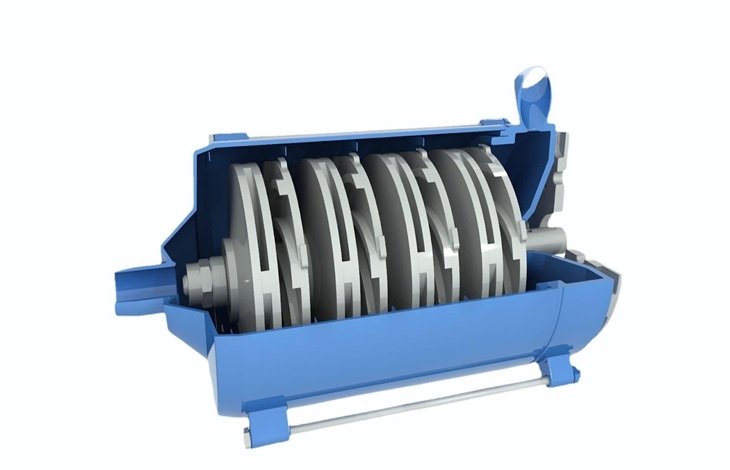
Multi-stage centrifugal blowers compress air across several impellers, allowing airflow and pressure to be adjusted more efficiently than fixed-speed positive displacement systems.
How Aeration Demands Change Throughout the Day
Industries that manage wastewater deal with fluctuating loads throughout the day. Morning sewage flows differ from evening loads, and summer patterns don’t match winter patterns. A fixed-speed blower sized for peak demand runs continuously at full capacity even during quieter periods. The extra air rises through the tank as wasted bubbles because microbes can only process what they need, and you’ve paid to compress air that never transfers oxygen.
Variable frequency drives match blower output to dissolved oxygen targets in real time. The system delivers exactly what the biomass needs and backs off when demand drops.
Where Fixed-speed Blowers Waste Energy
Inlet valves on fixed-speed blowers create mechanical losses that show up as heat and wear. The valve restricts airflow while the motor runs at full power, forcing all that energy into pushing air through a narrowed opening. Industry energy benchmarking and operational guidance shows excessive inlet restriction increases electricity consumption because throttles must be adjusted more frequently, pushing units to maximum energy use for extended periods. Multi-stage centrifugal blowers paired with variable frequency drives adjust motor speed rather than choking the inlet.
Motor housings run cooler when energy-efficient industrial equipment isn’t straining against throttled inlets. Bills drop, and bearings last longer because components aren’t dealing with constant thermal stress. Interfil builds units at the Mortdale facility with Australian humidity and ambient temperatures already factored into tolerances. Units designed for local ambient conditions tend to perform more consistently in Australian environments.
FAQs
Will switching blowers actually cut our energy bills?
Yes. Multi-stage centrifugal blowers with variable frequency drives consume significantly less energy than fixed-speed rotary lobe systems because they adjust to actual demand instead of running at full power continuously.
Do multi-stage blowers work with existing diffuser systems?
Most multi-stage centrifugal blowers can be integrated with existing diffuser grids and piping without major modifications if the new unit matches or slightly exceeds the previous airflow capacity.
Can one blower handle varying pressure needs?
No. Each blower is optimised for a specific pressure range, so sites with multiple zones requiring different pressures need separate units sized for each application.
What Makes Multi-stage Centrifugal Blowers Different
A multi-stage centrifugal blower stacks multiple impellers in series. Each stage adds pressure incrementally rather than forcing everything through a single compression cycle, so the motor doesn’t fight the same mechanical losses you see in positive-displacement designs. Heat build-up drops, power draw per cubic metre decreases, and there’s no pulsing to shake pipework loose or wear out gaskets.
Interfil manufactures units in configurations from single-stage to five-stage, with standard models delivering pressures up to 30 kPa and vacuum levels up to 25 kPa. Sites handling corrosive materials or chemically aggressive environments can specify protective impeller coatings.
Where Blower Sizing Affects Efficiency
Most plants run on equipment sized for future capacity that never arrives. Nameplate ratings overstate actual requirements, and peak loads typically run well below the original design spec. Interfil’s technical team works from measured air demand data to size equipment that improves industrial operations efficiency without wasted capacity. Contact Interfil to discuss actual operating airflow and pressure demand, and how sizing adjustments can reduce wasted capacity.
Read Also:
Wastewater Filter Media Performance: Key Factors That Influence Filtration Efficiency
The Benefits of Fuel Purifiers in Ensuring Clean and Efficient Fuel Systems