

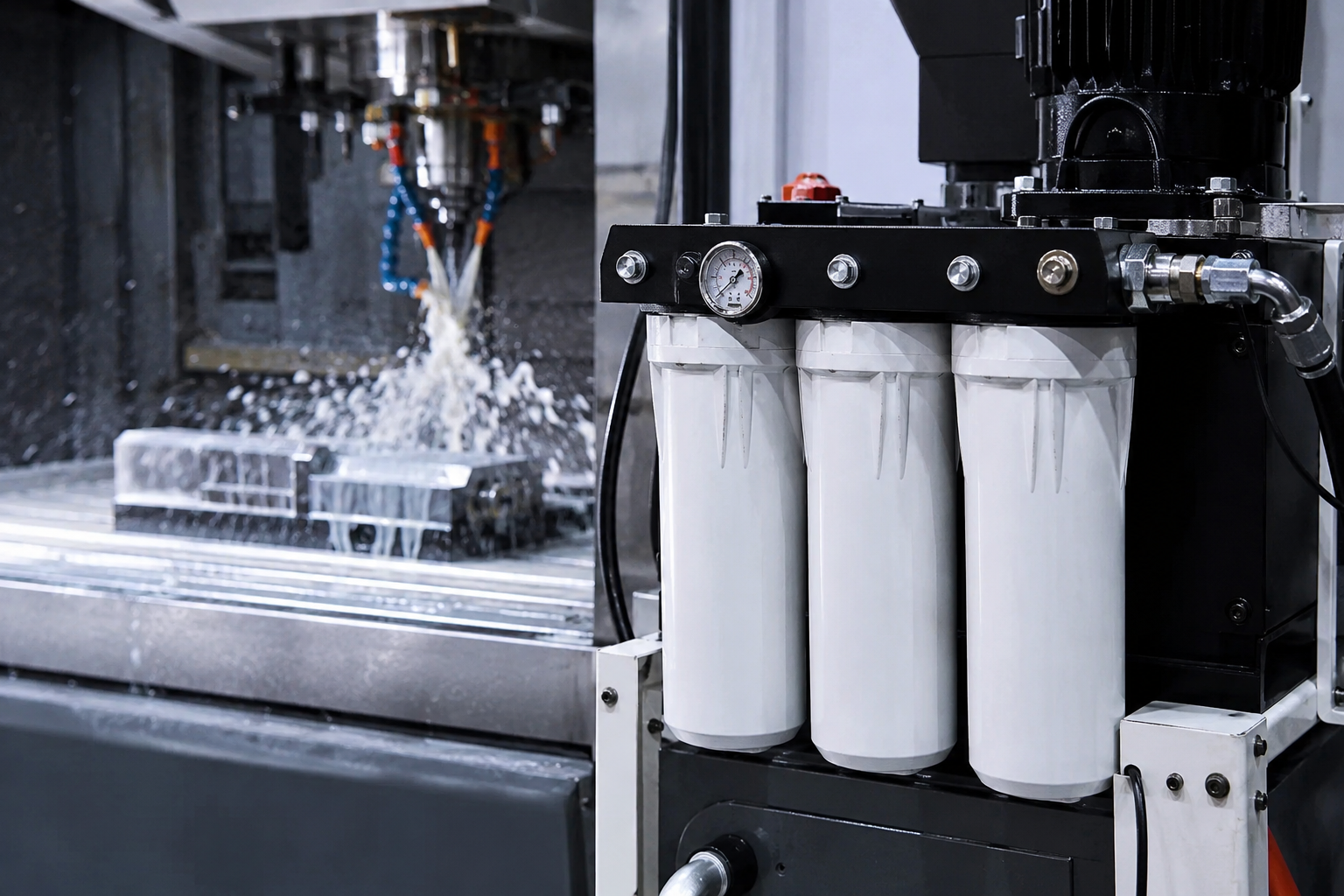
A coolant filtration system helps CNC and metalworking operations maintain machining accuracy, extend tool life and reduce coolant replacement costs. Without effective filtration, contaminants such as metal fines, swarf, tramp oil and grinding dust circulate through the system, accelerating equipment wear and increasing downtime.
Choosing the right coolant filtration system involves more than removing debris. The filtration technology must suit the machining process, coolant type, contaminant size and production requirements. Selecting appropriate coolant filtration equipment also depends on how filtration integrates with the wider production process.
This guide explains how coolant filtration works, compares the main filtration technologies and outlines the key factors to consider when selecting a system for CNC and metalworking applications.
What Is a Coolant Filtration System?
A coolant filtration system is equipment designed to continuously or periodically remove contaminants from metalworking coolant, enabling it to be reused efficiently throughout machining operations.
Rather than allowing particles to accumulate inside coolant tanks, pumps and pipework, filtration systems separate unwanted material before it can damage equipment or affect machining quality.
Depending on the application, contaminants may include:
- Ferrous and non-ferrous metal particles
- Grinding dust
- Fine metal particles
- Tramp oil
- Sludge
- Biological contamination
- Suspended solids
Modern industrial coolant filtration systems can operate as:
- Stand-alone filtration units
- Centralised filtration plants
- Machine-specific filtration systems
- Continuous recirculating filtration systems
The appropriate solution depends on production volume, machine configuration, coolant capacity and the type of material being machined.
For many Australian manufacturers, effective filtration is part of a broader coolant management strategy that also includes tramp oil removal, coolant monitoring, and preventive maintenance.
Why Coolant Filtration Matters in CNC and Metalworking Operations
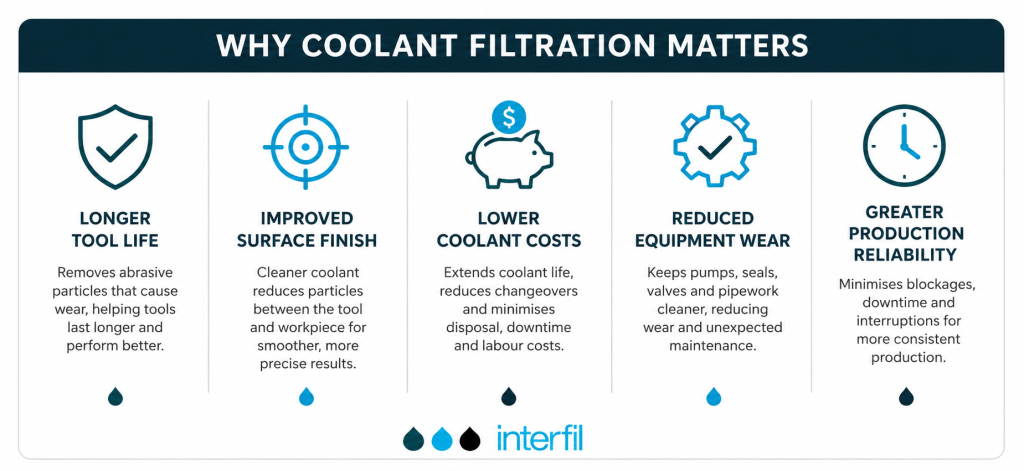
Effective coolant filtration supports longer tool life, better surface finishes, lower operating costs and more reliable CNC and metalworking production.
Machining coolant is a working fluid rather than a consumable that should be discarded frequently. When maintained correctly, coolant can remain effective for significantly longer, reducing waste and lowering operating costs.
A properly selected coolant filtration system in Australia that manufacturers rely on helps improve several aspects of production.
Longer tool life
Hard metal particles suspended in coolant act as abrasives. As these particles recirculate through the cutting zone, they accelerate wear on cutting inserts, drills, end mills and grinding wheels.
Cleaner coolant reduces this abrasive action, allowing tools to maintain their cutting edge for longer and improving consistency between tool changes.
Improved surface finish
Fine contaminants interfere with machining precision by remaining between the cutting tool and workpiece.
Removing these particles helps produce smoother finishes, tighter dimensional tolerances and greater consistency, particularly during finishing operations.
Lower coolant replacement costs
Replacing coolant involves more than purchasing fresh fluid.
Manufacturers must also account for:
- Machine downtime
- Cleaning coolant tanks
- Disposal of used coolant
- Labour costs
- Production interruptions
Maintaining coolant cleanliness extends coolant service life and reduces the frequency of complete system changeovers.
Reduced equipment wear
Contaminated coolant can damage:
- Pumps
- Seals
- Valves
- Pipework
- Coolant delivery nozzles
Removing abrasive particles reduces mechanical wear throughout the coolant circulation system.
Greater production reliability
Blocked coolant lines, clogged filters, and contaminated tanks often cause unexpected downtime.
Consistent filtration helps minimise these disruptions while supporting more predictable production scheduling.
Common Sources of Coolant Contamination
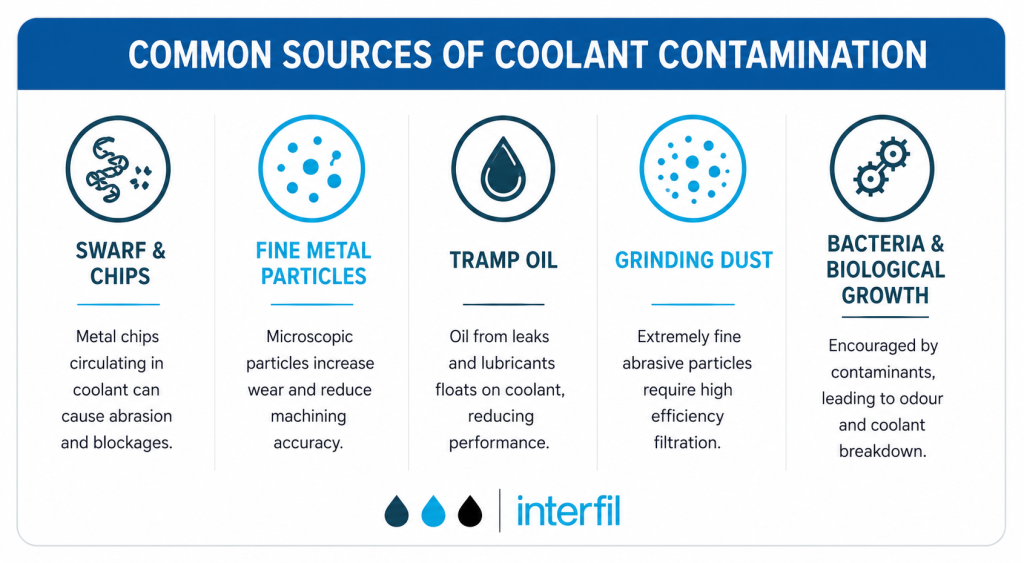
Common coolant contaminants include metal chips, fine particles, tramp oil, grinding dust and biological growth, all of which can affect machining performance.
Understanding the source of contamination makes it easier to select appropriate filtration equipment. Different machining processes generate different contaminant types, and no single filtration technology is suitable for every application.
Swarf and machining chips
The most obvious contaminants are chips produced during cutting.
Large chips generally settle quickly, but smaller chips remain suspended in the coolant and continue circulating through the machine.
High-production machining centres often generate substantial volumes of swarf that require continuous removal to prevent coolant overflow and pump blockage.
Fine metal particles
Modern CNC machining frequently produces extremely fine particles that remain suspended in coolant for extended periods.
These microscopic particles are among the most damaging because they:
- Increase abrasive wear
- Reduce filtration efficiency
- Affect machining accuracy
- Contribute to sludge formation.
Grinding operations are particularly challenging because they generate very fine metallic and abrasive particles.
Tramp oil
Hydraulic oil, spindle lubricants and way lubricants often leak into coolant systems during normal machine operation.
Unlike coolant, tramp oil floats on the coolant surface where it can:
- Reduce oxygen transfer
- Encourage bacterial growth
- Produce unpleasant odours
- Destabilise coolant chemistry
Many coolant management systems combine filtration with tramp oil separation to maintain coolant quality.
Grinding dust and abrasive particles
Grinding applications introduce unique contamination challenges because grinding wheels release extremely fine abrasive material alongside metal particles.
These contaminants are often significantly smaller than conventional machining swarf and require specialised filtration capable of capturing micron-sized particles.
Processes involving carbide, hardened steel or precision grinding generally require higher filtration efficiency than conventional machining operations.
Bacteria and biological growth
Water-miscible coolants provide favourable conditions for bacterial and fungal growth when contamination is allowed to accumulate.
Microbial activity can cause:
- Unpleasant odours
- Coolant degradation
- Skin irritation for operators
- Reduced coolant performance
- Shortened coolant life
While filtration alone cannot eliminate biological contamination, removing suspended solids and tramp oil helps maintain healthier coolant conditions and supports more stable coolant chemistry.
Types of Coolant Filtration Systems
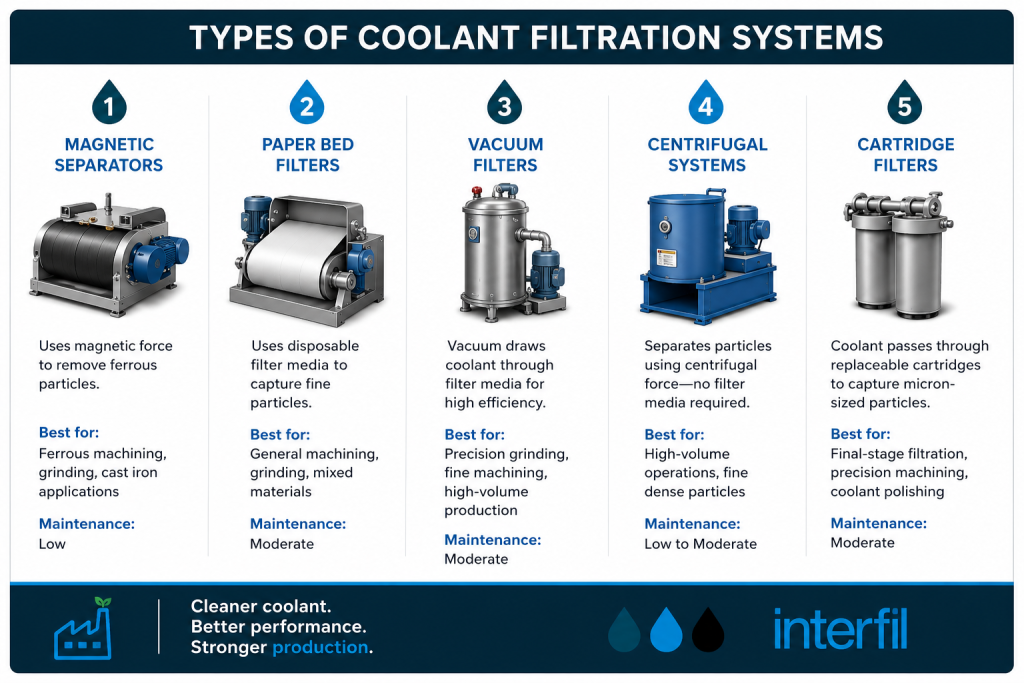
Common coolant filtration systems vary in filtration method, suitable machining applications and maintenance requirements.
Selecting the right coolant filtration system begins with understanding how different technologies operate. Each filtration method is designed to handle specific contaminant types, flow rates and machining applications.
Many facilities combine multiple technologies within a single system to achieve higher coolant cleanliness and longer coolant life.
Magnetic separators
Magnetic separators remove ferrous particles from coolant using powerful permanent or electromagnetic assemblies.
As contaminated coolant flows through the separator, magnetic particles adhere to rotating drums or magnetic elements, then are continuously discharged into collection bins.
Best suited for
- Cast iron machining
- Steel machining
- Grinding operations
- Ferrous metal processing
Advantages
- No consumable filter media
- Continuous operation
- Low maintenance requirements
- High reliability
- Effective removal of ferrous fines
Limitations
- Only removes magnetic materials.
- Not suitable for aluminium, brass or stainless steel contaminants
Magnetic separators are often used as the first stage of filtration before finer filtration equipment removes remaining non-magnetic particles. This staged approach is common in facilities using magnetic separators alongside secondary filtration to improve overall coolant cleanliness.
Paper bed filters
Paper bed filters use disposable filter media to capture contaminants as coolant flows through the filtration bed.
As debris accumulates, fresh filter media automatically advances to maintain coolant flow and filtration efficiency.
These systems are widely used across machining and grinding applications where consistent removal of fine particles is required.
Best suited for
- General CNC machining
- Surface and cylindrical grinding
- Medium to high production environments
- Mixed-material machining operations
Advantages
- Reliable fine-particle removal
- Automatic media advancement
- Suitable for a wide range of machining processes
- Consistent coolant quality
Limitations
- Ongoing filter media replacement
- Disposal of used filter paper
- Higher consumable costs than media-free systems
Vacuum filters
Vacuum filters use negative pressure to draw coolant through a filter media, capturing very fine particles before returning clean coolant to the system. They are commonly used where a high level of filtration is required and are well-suited to continuous production environments.
Compared with gravity-fed systems, vacuum filters can maintain consistent filtration rates even as contaminants accumulate on the filter media.
Best suited for
- Precision grinding
- Fine machining
- High-volume CNC production
- Applications requiring fine particle removal
Advantages
- High filtration efficiency
- Handles fine contaminants effectively
- Supports automated operation
- Consistent coolant quality
Limitations
- Higher capital cost
- More complex than basic filtration systems
- Requires routine maintenance of vacuum components
Centrifugal filtration systems
Centrifugal systems separate contaminants using centrifugal force rather than filter media. As coolant spins at high speed, heavier particles move towards the outside of the rotor where they collect for removal.
Because they do not rely on disposable filter media, centrifugal systems can reduce ongoing operating costs in suitable applications.
Best suited for
- Fine metal particles
- High coolant volumes
- Continuous industrial operation
- Operations seeking lower consumable costs
Advantages
- No disposable filter media
- Low waste generation
- Continuous operation
- Effective removal of fine solids
Limitations
- Less effective for very light contaminants
- Performance depends on particle density.
- Higher initial investment
Cartridge filtration
Cartridge filters force coolant through replaceable filter cartridges designed to capture particles down to a specified micron rating.
These systems are often installed as polishing filters after primary filtration stages or where extremely clean coolant is required.
Best suited for
- Final-stage filtration
- Precision machining
- Coolant polishing
- Low-to-medium flow applications
Advantages
- High filtration accuracy
- Available in multiple micron ratings
- Simple installation
- Suitable for a wide range of coolants
Limitations
- Ongoing cartridge replacement costs
- Filters require regular monitoring.
- Less economical for very high contamination loads
Coolant Filtration Technology Comparison
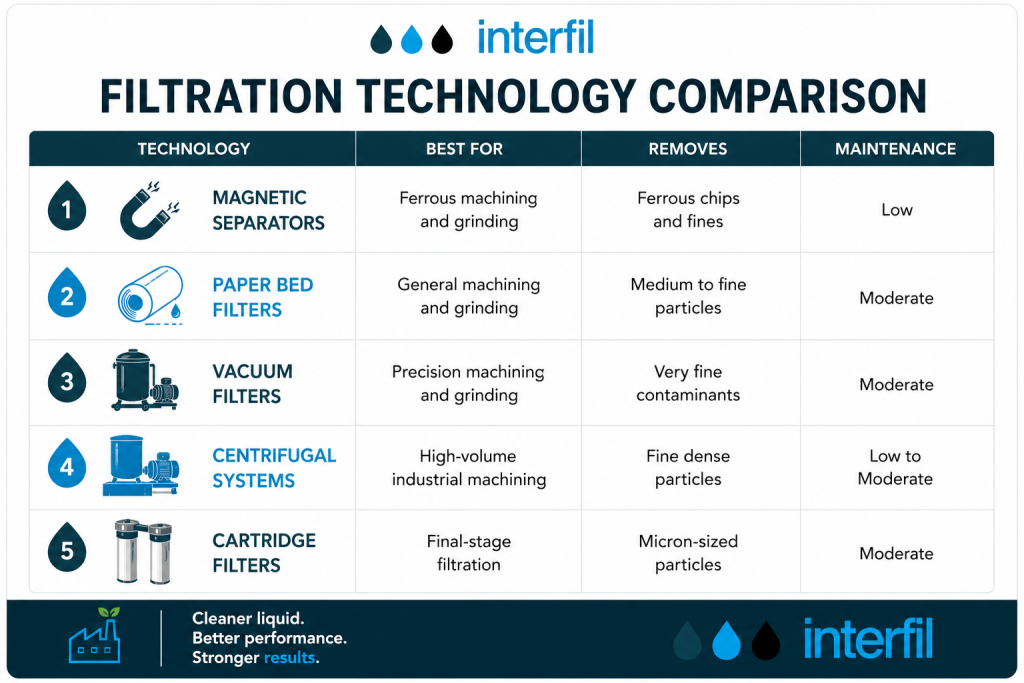
A comparison of common coolant filtration technologies based on suitable applications, contaminants removed and maintenance requirements.
Many manufacturing facilities achieve better results by combining multiple filtration technologies. For example, a magnetic separator can remove larger ferrous particles before a paper bed or cartridge filter captures finer non-magnetic contaminants, improving coolant cleanliness while reducing wear on downstream equipment.
How to Choose the Right System
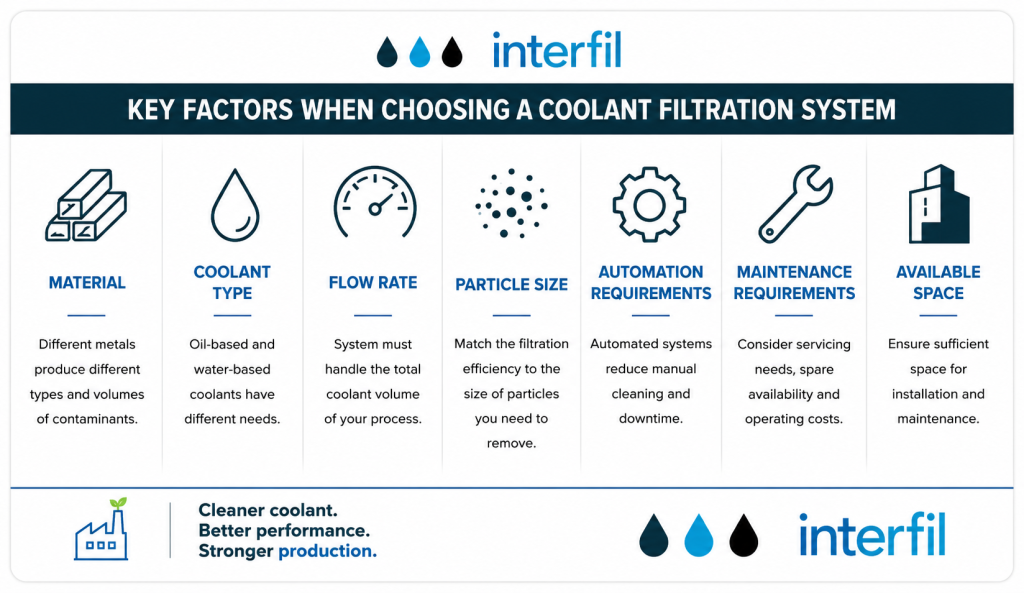
Material type, coolant characteristics, flow rate, particle size and operational requirements all help determine the right coolant filtration system
The best coolant filtration system is one that matches the contaminants being generated, production requirements and maintenance capabilities. Selecting equipment solely on purchase price can lead to higher operating costs if the system is undersized or unsuitable for the application.
Material Being Machined
Different metals generate different contaminant profiles.
- Cast iron produces large quantities of magnetic fines.
- Steel generates magnetic chips and swarf.
- Aluminium produces lightweight, non-magnetic particles.
- Stainless steel and exotic alloys often require finer filtration because of their machining characteristics.
Understanding the material being processed helps determine whether magnetic separation, mechanical filtration or a combination of both is the most suitable approach.
Coolant Type
Straight oils and water-miscible coolants behave differently during filtration.
Oil-based coolants typically require systems designed to manage higher viscosity, while water-based coolants may also require tramp oil removal and bacterial management as part of the overall coolant maintenance strategy.
Flow Rate
The filtration system must be capable of handling the total coolant volume generated during production.
Undersized equipment may struggle to keep pace with machining operations, leading to the accumulation of contaminants despite continuous filtration.
Particle Size
Not all contaminants are visible to the naked eye.
Large swarf can often be removed using coarse filtration, while grinding operations may generate particles measured in only a few microns. Choosing a system with the appropriate filtration efficiency helps prevent unnecessary wear and maintain coolant quality.
Automation Requirements
Manufacturers operating multiple CNC machines often benefit from automated filtration systems that reduce manual cleaning and minimise production interruptions.
Features such as automatic sludge removal, self-cleaning operation and filter media indexing can improve efficiency while reducing labour requirements.
Maintenance Requirements
Every filtration technology requires maintenance, but the level of servicing varies.
Before purchasing equipment, consider:
- Ease of cleaning
- Replacement part availability
- Consumable costs
- Service intervals
- Accessibility for maintenance staff
A simpler system that operators can maintain consistently may outperform a more sophisticated system that receives limited attention.
Available Floor Space
Some centralised coolant filtration systems require significant installation space, while compact machine-mounted units are better suited to facilities with limited floor area.
Planning for maintenance access, sludge collection and future expansion helps avoid costly layout changes later.
Signs Your Current Filtration System Isn’t Performing
Filtration performance often declines gradually, making problems easy to overlook until they begin affecting production quality.
Common warning signs include:
- Frequent coolant replacement
- Poor surface finish on machined components
- Excessive cutting tool wear
- Blocked coolant nozzles
- Pump failures or restricted coolant flow
- Sludge is accumulating in the coolant tanks.
- Unpleasant coolant odours
- Visible tramp oil on coolant surfaces
- Increased machine cleaning requirements
- Higher maintenance costs
If several of these issues occur together, it may indicate that the existing coolant filter system is no longer suited to current production demands or requires servicing.
Maintenance Tips for Long-Term Performance
Even the best coolant filtration equipment performs poorly without regular maintenance. A structured maintenance schedule helps maximise filtration efficiency, extend equipment life and reduce unexpected downtime.
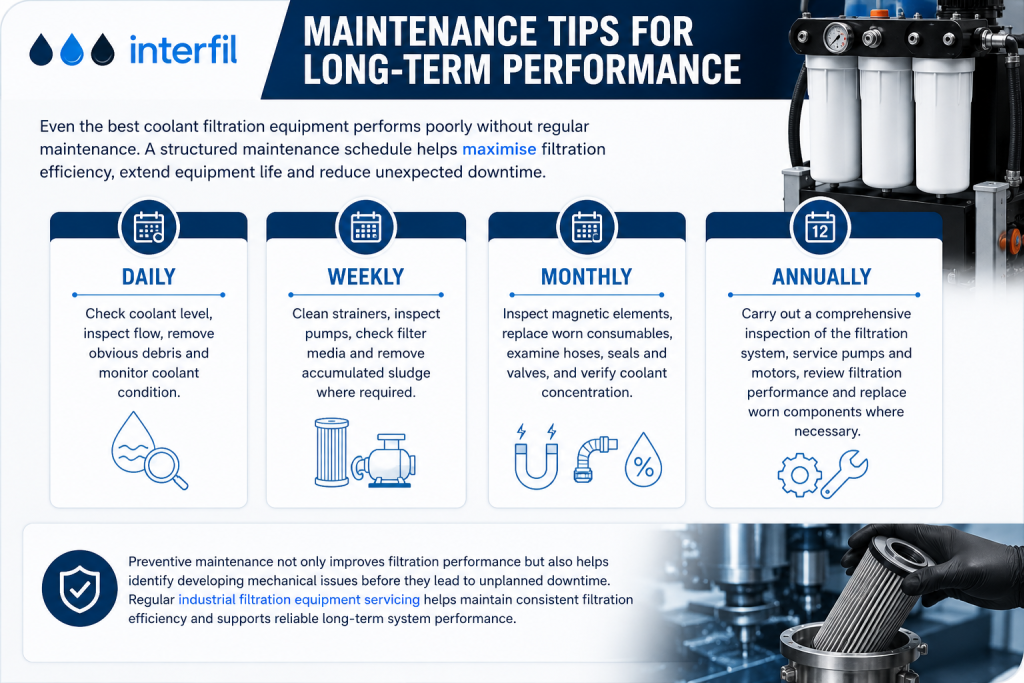
Regular coolant filtration system maintenance helps maintain filtration efficiency, extend equipment life and reduce unexpected downtime.
Preventive maintenance not only improves filtration performance but also helps identify developing mechanical issues before they lead to unplanned downtime. Regular industrial filtration equipment servicing helps maintain consistent filtration efficiency and supports reliable long-term system performance.
How Interfil Supports Australian Manufacturers
Industrial filtration requirements vary significantly between machining operations. Factors such as material type, coolant chemistry, machine configuration and production volume all influence the most appropriate solution.
With decades of experience supplying industrial filtration equipment across Australia, Interfil works with manufacturers to provide customised coolant filtration systems that match individual operating requirements rather than relying on a one-size-fits-all approach. The company’s range includes magnetic separators, industrial filtration equipment, filter media and engineered filtration solutions suitable for a wide variety of CNC machining and metalworking applications.
As the Australian distributor of Hoffmann Filter technologies, Interfil also provides proven filtration solutions for demanding manufacturing environments. Combined with ongoing technical support, system servicing and replacement filter media, these solutions help manufacturers maintain coolant quality and optimise long-term equipment performance.
Frequently Asked Questions
How often should coolant be filtered?
Coolant should ideally be filtered continuously during machining. Continuous filtration prevents contaminants from accumulating and helps maintain consistent coolant quality throughout production.
What contaminants can coolant filtration remove?
Depending on the filtration technology used, coolant filtration can remove swarf, fine metal particles, grinding dust, sludge, tramp oil and other suspended contaminants.
Can coolant filtration extend tool life?
Yes. Removing abrasive particles reduces cutting-edge wear, allowing tools to maintain performance longer, improve machining consistency, and help reduce tooling costs.
How do magnetic coolant filters work?
Magnetic filtration uses powerful magnets to capture ferrous particles from circulating coolant. The collected material is then removed from the magnetic surface while clean coolant continues through the system.
Which coolant filtration system is best for CNC machining?
There is no single solution suitable for every CNC application. The best system depends on the material being machined, coolant type, contaminant size, production volume and required filtration performance. Many manufacturers achieve the best results by combining multiple filtration technologies.
Conclusion
Selecting the right coolant filtration system helps improve machining consistency, extend coolant and tool life, and reduce maintenance-related downtime. The best solution depends on factors such as the material being machined, coolant type, contaminant size and production requirements.
With engineered filtration solutions, including magnetic separators and customised coolant filtration systems, Interfil supports Australian manufacturers in implementing reliable filtration that aligns with their operational needs and long-term performance goals.