

Poor liquid waste segregation can turn several manageable waste streams into one difficult treatment problem. When oils, coolants, suspended solids, wash water and other process liquids are unnecessarily combined, facilities can increase treatment requirements, place additional loads on equipment and reduce opportunities to recover water or process fluids.
For manufacturing, mining, food processing and metalworking operations, effective liquid waste management starts before filtration. It begins with understanding what each process produces and determining which streams should remain separate.
What is liquid waste segregation?
Liquid waste segregation is the practice of keeping wastewater and process-fluid streams separate according to their contaminants, characteristics and treatment requirements.
A metalworking facility, for example, may generate coolant containing fine metal particles, oily equipment wash water and relatively clean rinse water. Combining these streams means the downstream treatment system may need to handle solids, oil and other contaminants across the entire volume.
Mining sites can face similar challenges. Sediment-heavy water may require solids separation, while hydrocarbon-contaminated runoff from workshop activities can require a different treatment approach.
Segregation takes place before wastewater filtration, oil-water separation or sludge dewatering. Operators first need to understand where each liquid originates, which contaminants are likely to be present, how its characteristics vary and whether the water or process fluid has realistic recovery potential.
The NSW EPA Waste Classification Guidelines also highlight the importance of understanding and correctly classifying waste. The guidelines state that, where practicable, safe and appropriate, mixtures containing different waste classes should be separated before being classified individually. They also prohibit mixing waste classes for the purpose of diluting chemical contaminants.
Why does segregation change the treatment process?
Separating liquid waste streams allows treatment to target the contaminants in each stream instead of managing every contaminant across one combined wastewater volume.
Suppose machining coolant contains metal fines while equipment cleaning produces wastewater containing free oil. If both are mixed with relatively clean rinse water, those contaminants are distributed across a larger volume.
Keeping the streams separate creates more treatment options. Coolant can remain within a dedicated circuit, solids-heavy wastewater can undergo an appropriate separation process, and oily wastewater can be assessed for oil-water separation.
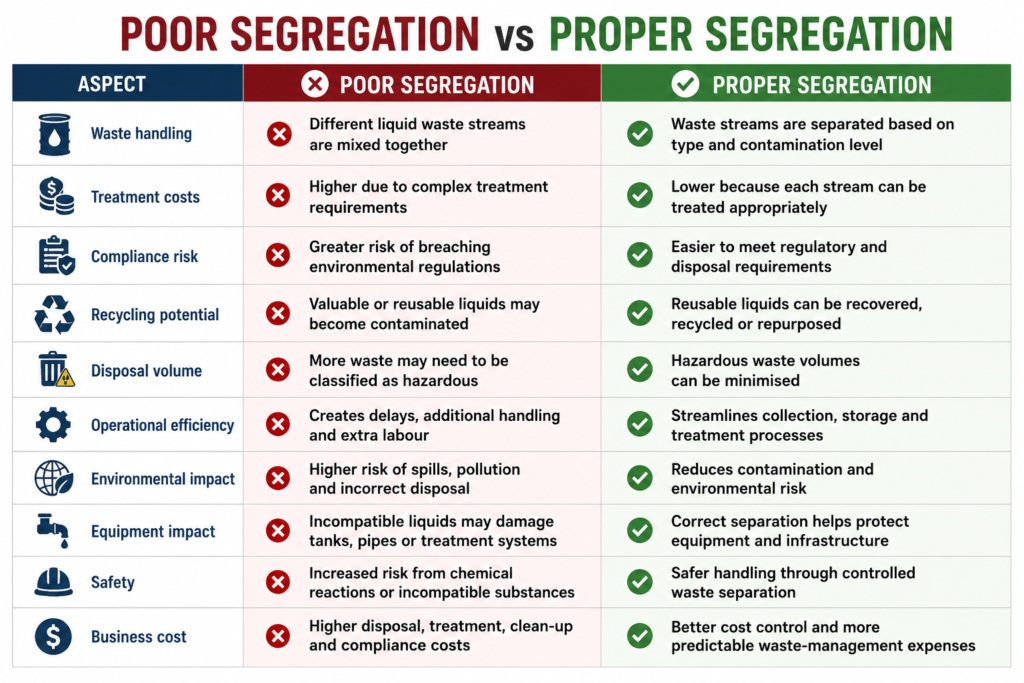
Separating liquid waste by type and contamination level allows each stream to receive appropriate treatment.
Segregation does not remove contaminants. Its purpose is to control where they go before industrial wastewater treatment begins. Filtration remains an important downstream process, but segregation determines what reaches the treatment system in the first place.
Hidden cost #1: Higher disposal requirements
Combining streams with different levels or types of contamination can increase the volume of wastewater requiring treatment or disposal.
If a relatively small contaminated stream is mixed with a much larger, less contaminated stream, the facility may lose the opportunity to manage the cleaner portion separately. Instead, the entire combined volume may require further treatment before it can be recovered or disposed of appropriately.
Sludge creates another practical issue. Wet sludge contains liquid that remains part of the material being stored, handled and transported. Where appropriate, sludge dewatering separates liquid from concentrated solids and produces a drier solids fraction for subsequent handling.
Preventing unnecessary mixing upstream can therefore be just as important as improving the treatment process itself.
Hidden cost #2: Increased equipment wear and maintenance
Mixed waste streams can send unnecessary contaminants through pumps, filters, sumps and pipework.
Metal fines increase the solids load reaching downstream equipment and can contribute to blockages and wear. Machining coolant can also accumulate particles and tramp oil as it circulates through a production process.
Keeping coolant within a dedicated coolant filtration circuit allows these contaminants to be managed without automatically combining the fluid with general manufacturing wastewater.
Poor segregation can also result in filters being exposed to contaminants they were not intended to handle, potentially increasing cleaning or media replacement requirements.
The first decision is therefore not which filter to install. It is determining what should reach the filter.
Hidden cost #3: Lost water and fluid recovery opportunities
Potentially recoverable water becomes more difficult to treat when it is unnecessarily mixed with oils, chemicals or heavily contaminated wastewater.
Waste streams generated within the same facility can have very different characteristics. In food processing, for example, one stream may contain suspended food solids while cleaning processes introduce different contaminants.
Free oil provides another example. Keeping an oil-contaminated stream identifiable can make oil-water separation more practical than distributing that contamination throughout a larger wastewater volume.
For suitable applications, oil skimmers can remove floating free and tramp oil from coolant, process water, pits and settling tanks.
Some industrial wastewater can also be treated for reuse, although suitability depends on the contaminants present, the treatment process and the water quality required for the intended application. Interfil has previously explored how advanced wastewater recycling technologies can support water recovery across industrial environments.
Effective wastewater recycling therefore begins by protecting streams that have realistic recovery potential rather than unnecessarily contaminating them upstream.
Hidden cost #4: More complicated environmental compliance
Uncontrolled mixing can make wastewater characteristics less predictable, complicating sampling, classification, treatment and recordkeeping.
Facilities need to understand the waste they generate and how it moves through the site. When several process streams enter the same tank, wastewater characteristics can change as production activities change.
For example, a stream that mainly contains suspended solids could later receive oils or chemicals from another process. This creates a more variable waste stream and can make it harder to determine what treatment is required.
Keeping streams separate can improve traceability. Operators can more readily document where waste originates, which contaminants are expected, where the waste is stored and how it is subsequently treated.
Environmental requirements depend on the type of waste, the facility, the jurisdiction and the receiving system. Segregation supports better waste control and recordkeeping, but does not by itself establish that discharge or disposal requirements have been met.
Hidden cost #5: Reduced productivity
Poor segregation can also appear as repeated maintenance and interruptions rather than as an obvious wastewater problem.
Filters may block more frequently, sumps require additional cleaning, solids accumulate in pumps or pipework, and contaminated coolant may need extra attention.
Each interruption uses maintenance resources and may affect the production process supported by the liquid system.
More consistent waste streams make downstream treatment easier to manage because operators have a clearer understanding of the expected solids, oils and flow conditions reaching the equipment.
This is particularly important where filtration equipment operates continuously or supports a process that cannot easily be stopped for unplanned cleaning.
Best practices for liquid waste segregation
Effective liquid waste segregation begins by mapping each stream from its point of generation through to treatment, recovery or disposal.
Start at the production process rather than the wastewater tank. Identify machining, washing, rinsing, maintenance and other activities that produce liquid waste.
For each stream:
- identify the likely solids, oils and chemicals present
- document typical volumes and flow conditions
- consider how the stream changes during production or cleaning
- determine whether mixing it with another stream creates an avoidable treatment problem
- assess whether water, coolant, oil or another resource has recovery potential
- identify where the stream is stored and transferred.
Relatively clean rinse water, for example, should not automatically be combined with oily wastewater simply because both eventually leave the production area.
Clearly identified tanks, sumps and transfer lines can help maintain separation. Sampling can then confirm whether expected wastewater characteristics reflect actual operating conditions.
Segregation arrangements should also be reviewed when raw materials, cleaning chemicals, machining fluids or production methods change.
These decisions support waste minimisation by reducing unnecessary contamination before treatment begins.
How Interfil supports industrial liquid waste treatment
Once waste streams have been assessed and appropriately separated, filtration and separation equipment can be matched to the contaminants, process conditions and required outcome.
Interfil is an Australian-owned company that began operations in 1986, initially specialising in coolant filtration for manufacturing. Its capabilities have since expanded across wastewater filtration, sludge dewatering, centrifuges, oil skimming, filter media and other industrial separation applications.
Different contamination problems require different approaches. Industrial centrifuges can separate suspended solids from suitable liquids, while oil skimmers target floating oils. Wastewater filtration and sludge dewatering systems separate liquids from solids, and filtration media can be selected according to the characteristics of the application.
Interfil’s wastewater capabilities also include turnkey systems incorporating design and installation, mixing tanks, pumps and auxiliary components.
Equipment selection should therefore follow waste-stream assessment rather than precede it. Understanding where contaminants originate and keeping suitable streams separate can reduce unnecessary treatment and provide more consistent conditions for downstream equipment.
Frequently asked questions
What is liquid waste segregation?
Liquid waste segregation means keeping wastewater and process-fluid streams separate according to their contaminants and treatment requirements. This prevents manageable liquids from becoming unnecessarily mixed with more difficult waste streams.
Why is liquid waste segregation important?
Segregation allows treatment to be matched more closely to the contaminants present. It can reduce unnecessary treatment and disposal requirements, limit contaminant loading on equipment and preserve opportunities for recovery or reuse.
Can industrial wastewater be recycled?
Some industrial wastewater can be treated for reuse. Whether this is practical depends on the contaminants present, the treatment available and the water quality required for the intended application.
What industries benefit from liquid waste segregation?
Manufacturing, metalworking, mining, food processing, construction and other industries that generate multiple liquid waste streams can benefit from better segregation. The appropriate approach depends on each facility’s processes and contaminants.
What happens if wastewater isn’t separated?
Contaminants can become distributed throughout a larger volume of wastewater, making treatment more complex. Poor segregation may also reduce recovery opportunities and increase the contaminant load reaching downstream equipment.
What equipment is used for industrial liquid waste management?
Common equipment includes wastewater filtration systems, centrifuges, sludge dewatering systems, oil skimmers, coolant filtration systems and filter media. Equipment should be selected according to the waste stream, contaminants, flow conditions and required treatment outcome.