

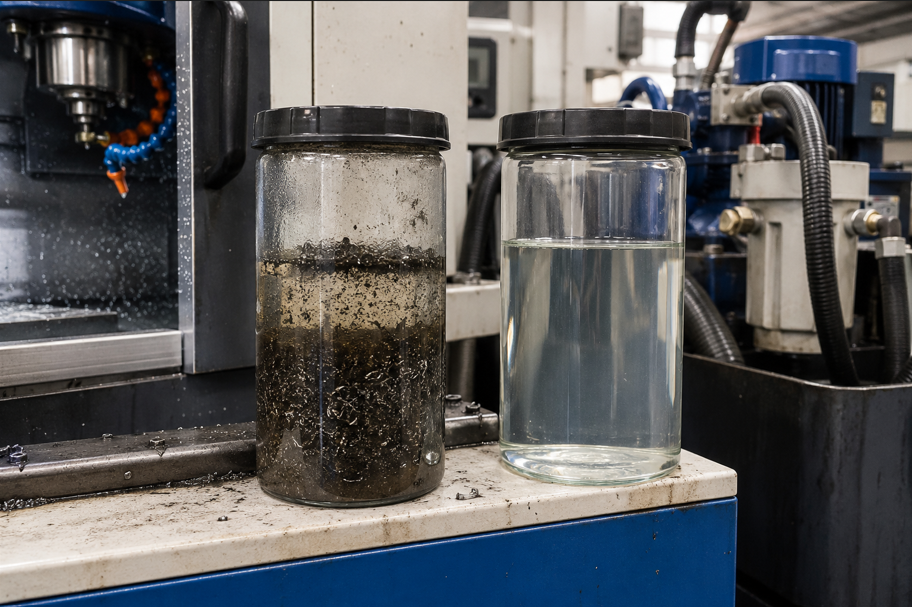
Sludge handling can account for a significant share of industrial wastewater treatment costs, making the right sludge dewatering system an important investment. The most suitable solution depends on factors such as sludge characteristics, throughput, available space, maintenance requirements and the required level of cake dryness. This guide explains the main dewatering technologies and the key considerations for selecting a system that delivers reliable, long-term performance.
What Is Sludge Dewatering?
Sludge dewatering is the mechanical process of removing water from sludge to reduce its volume and weight, making it easier and more economical to transport, handle and dispose of while allowing water to be recovered for further treatment or reuse.
Sludge is produced whenever solids are separated from liquids during industrial or wastewater treatment processes. Depending on the application, it may contain more than 95% water, making it extremely heavy despite containing relatively little solid material.
Common industries that generate sludge include:
- Manufacturing
- Mining and mineral processing
- Food and beverage production
- Metal finishing
- Chemical processing
- Pulp and paper manufacturing
- Municipal and industrial wastewater treatment
Removing excess water reduces disposal volumes, lowers transport costs and improves overall operational efficiency.
Why Sludge Dewatering Matters
Many organisations focus on wastewater treatment itself but underestimate the ongoing costs of sludge management. Because disposal contractors typically charge by weight or volume, reducing the amount of water contained in sludge can significantly lower transport, handling and disposal costs.
Well-designed sludge dewatering systems also improve operational efficiency, support water recovery and help businesses meet environmental compliance requirements.
Lower Disposal and Transport Costs
Untreated sludge contains large amounts of water, meaning businesses often pay to transport water rather than solid waste. Increasing the solids content reduces disposal volumes, lowers transport costs and decreases the number of waste collections required.
For facilities generating sludge every day, even modest improvements in cake dryness can deliver substantial long-term savings.
Benefits include:
- Lower disposal costs
- Reduced freight and fuel costs
- Less on-site sludge storage
- Fewer waste collections
- Improved site logistics
These savings are particularly valuable for regional operations where disposal facilities are located further away.
Water Recovery Opportunities
Many industrial wastewater treatment systems recover the liquid separated during dewatering for further treatment and reuse where appropriate. This can reduce freshwater consumption while improving overall water management. The suitability of recovered water depends on the treatment process and the application’s quality requirements.
Supporting Environmental Compliance
Effective sludge dewatering helps businesses:
- Reduce waste volumes sent for disposal
- Improve handling of regulated waste streams
- Support water recovery initiatives
- Reduce the environmental impact of waste transport
- Improve consistency within wastewater treatment operations
It can also reduce odour, minimise storage requirements and improve workplace safety by reducing the handling of highly liquid sludge.
Improving Overall Plant Efficiency
Removing water earlier in the treatment process reduces the load on pumps, storage tanks and downstream equipment. This simplifies sludge handling, improves process consistency and creates a more efficient wastewater treatment operation.
Understanding the Sludge Dewatering Process
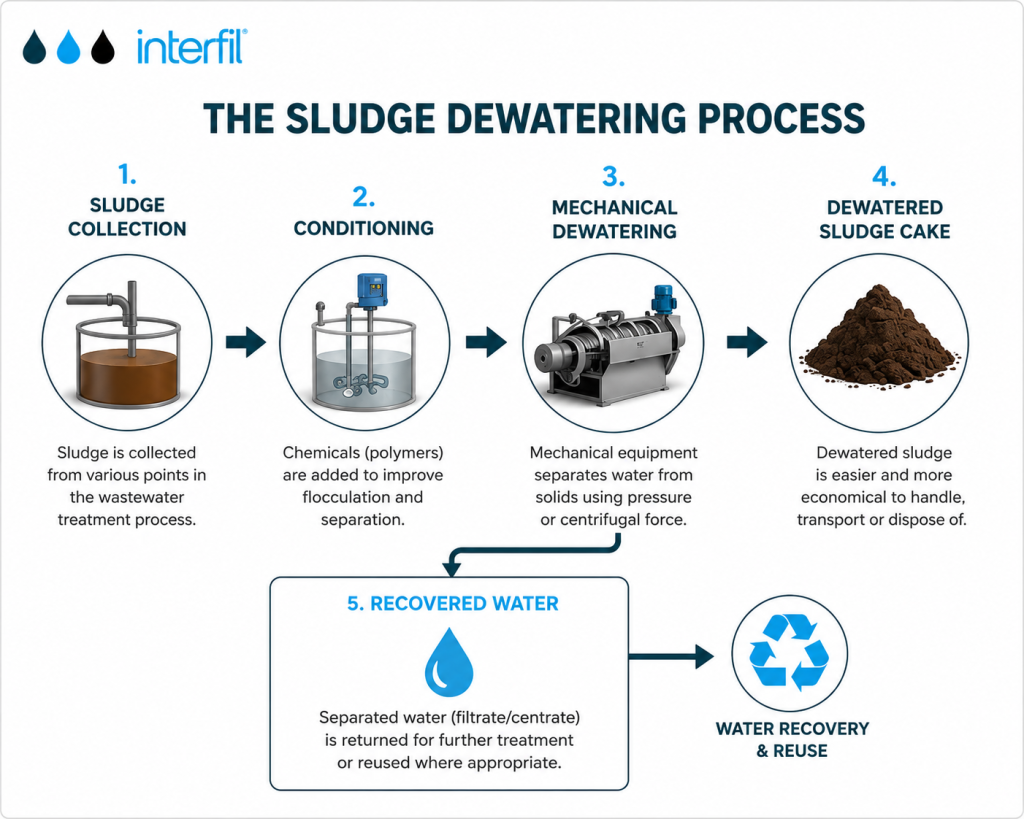
The sludge dewatering process separates water from solids through collection, conditioning and mechanical dewatering, producing sludge cake and recoverable water.
Although individual technologies differ, the sludge dewatering process generally follows the same sequence.
- Sludge is collected from the wastewater treatment process.
- The sludge is conditioned, often using polymers, to encourage fine particles to bind together.
- Mechanical equipment separates water from the solids.
- Dewatered solids (often referred to as sludge cake) are discharged for transport, disposal or beneficial reuse.
- The recovered liquid is returned for further treatment or reused where appropriate.
The effectiveness of each stage depends on sludge characteristics, equipment selection and process optimisation. Poor conditioning or selecting equipment that does not suit the sludge can significantly reduce dewatering performance.
Common Sludge Dewatering Technologies
No single sludge dewatering technology suits every application. Equipment selection depends on factors such as sludge characteristics, throughput, available space and operational requirements.
The comparison below outlines the most common sludge dewatering technologies and where they are typically used.
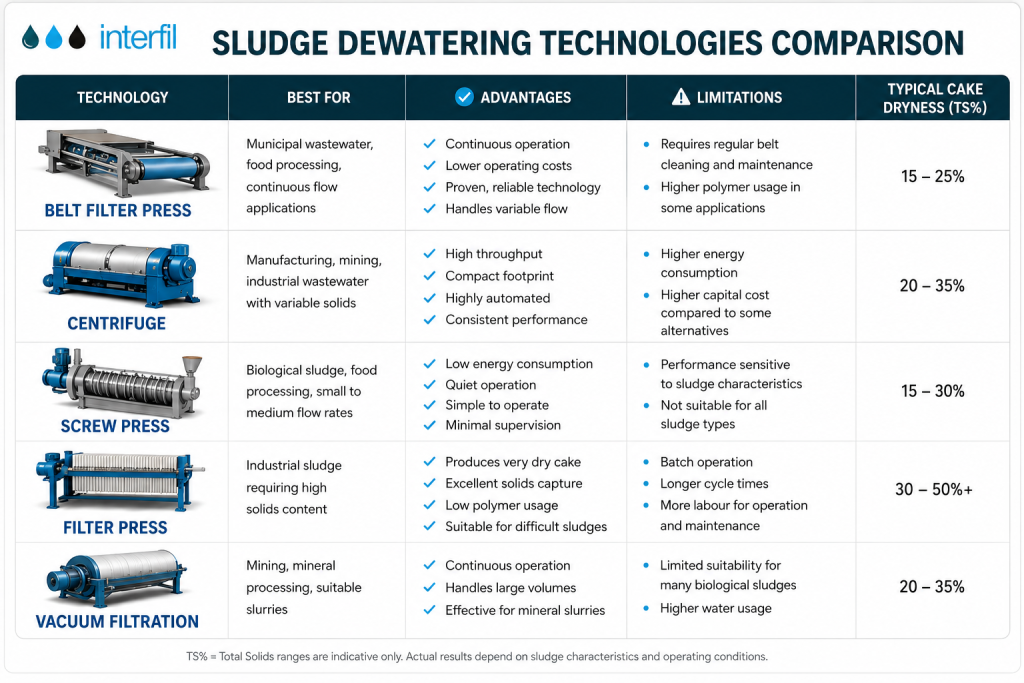
A comparison of common sludge dewatering technologies, their applications, advantages, limitations and typical sludge cake dryness.
Each offers different advantages depending on operational priorities rather than one being universally better than another.
Belt Filter Presses
Belt filter presses remove water by passing conditioned sludge through porous belts while gradually increasing mechanical pressure.
They are commonly used in municipal wastewater treatment and food processing where continuous operation is important.
Advantages include relatively simple operation, proven performance and comparatively low operating costs. Regular belt maintenance and cleaning are essential to maintain consistent performance.
Centrifuges
Centrifuges use high rotational speeds to generate centrifugal force that separates solids from liquids.
They are widely used for industrial sludge dewatering because they can process varying sludge volumes while maintaining consistent performance.
Their main advantages include:
- Continuous operation
- Compact footprint
- High processing capacity
- Automated operation
- Suitable for variable sludge loads
These characteristics make centrifuges well suited to manufacturing facilities and industrial wastewater treatment plants where space is limited.
Screw Presses
Screw presses compress sludge using a rotating screw housed within a cylindrical screen.
The gradual compression process provides relatively low energy consumption with minimal operator intervention. They are commonly selected for biological sludge applications where energy efficiency and continuous operation are priorities.
Performance, however, depends on sludge characteristics and appropriate conditioning.
Filter Presses
Filter presses use hydraulic pressure to force water through filter cloths while retaining solids within a series of chambers.
Their greatest advantage is producing very dry sludge cakes, making them well suited to applications where disposal costs are high or downstream processes require lower moisture content.
Because they operate in batches rather than continuously, cycle times should be considered when assessing production requirements.
Vacuum Filtration
Vacuum filtration creates a pressure difference that draws liquid through filter media while retaining solid particles.
Although less common in general wastewater treatment, it remains widely used in mining and mineral processing where slurry characteristics suit this separation method.
How to Choose the Right Sludge Dewatering System
Selecting a sludge dewatering system requires understanding both the wastewater process and the sludge characteristics. Comparing equipment specifications alone rarely delivers the best long-term outcome.
Consider the following factors before investing.
Start with Sludge Characteristics
No two sludge streams behave the same.
Before selecting equipment, understand:
- Solids concentration
- Particle size distribution
- Organic versus inorganic content
- Oil and grease levels
- Abrasiveness
- Chemical composition
- Flow variability
Laboratory analysis or pilot testing helps predict equipment performance under real operating conditions. Selecting equipment without understanding sludge characteristics can reduce throughput, increase polymer consumption and lower cake dryness.
Match System Capacity to Current and Future Throughput
A common mistake is selecting equipment based only on current production volumes.
A system should comfortably handle normal operating loads while allowing capacity for future growth or seasonal fluctuations. Equipment that is too small creates bottlenecks, while oversized equipment increases capital and operating costs.
Consider:
- Average daily sludge production
- Peak production periods
- Future expansion
- Operating hours
- Batch or continuous production
Designing for realistic operating conditions generally delivers better long-term efficiency.
Consider the Required Cake Dryness
The required cake dryness depends on how the sludge will be managed after dewatering. Sludge destined for landfill, composting, thermal treatment or resource recovery may each require different moisture levels.
Higher cake dryness often requires additional energy, chemicals or specialised equipment. Rather than targeting the driest possible cake, focus on achieving the best balance between disposal savings and operating costs.
A lifecycle cost assessment is usually more valuable than comparing moisture percentages alone.
Evaluate Automation Requirements
Modern sludge dewatering systems may include:
- Automated polymer dosing
- PLC and SCADA integration
- Remote monitoring
- Automatic shutdown protection
- Self-cleaning functions
- Performance monitoring and alarms
Automation can improve process consistency while reducing labour requirements. The appropriate level depends on operational complexity, staffing and maintenance capability.
Assess Maintenance Requirements Early
Maintenance costs continue throughout the life of the system, making serviceability an important consideration.
Consider:
- Scheduled servicing frequency
- Accessibility of wear components
- Spare parts availability
- Expected service life
- Maintenance downtime
- Local technical support
Equipment that is easier to maintain can reduce downtime and lower lifetime operating costs.
Consider Installation Space and Integration
Available space often determines which technology is practical.
The system should also integrate with existing infrastructure, including:
- Sludge storage tanks
- Polymer preparation systems
- Pumps
- Conveyors
- Pipework
- Electrical and control systems
Considering the entire treatment process helps minimise installation challenges and improve plant performance.
Compare Whole-of-Life Operating Costs
Purchase price is only one part of the investment decision.
Consider:
- Electricity consumption
- Polymer usage
- Maintenance
- Labour
- Replacement parts
- Water consumption
- Downtime
- Equipment lifespan
- Disposal savings
A higher upfront investment can often deliver lower operating costs over the life of the system.
Common Mistakes When Selecting a Dewatering System
Even well-managed projects can encounter problems when important operational factors are overlooked during equipment selection.
Buying Equipment Based on Price Alone
The lowest purchase price rarely delivers the lowest lifetime operating cost. Equipment with a lower upfront cost may require more energy, greater chemical consumption or more frequent maintenance, making a whole-of-life cost assessment a better basis for comparison.
Failing to Test Sludge Characteristics
Sludge properties vary significantly between industries and even between production processes. Particle size, fibre content, oil contamination, solids concentration and chemical composition all influence dewatering performance, making laboratory analysis or pilot testing an important step before selecting equipment.
Oversizing Equipment
Selecting equipment with substantially more capacity than required increases capital costs and can reduce operating efficiency. Systems should be sized to suit realistic production requirements while allowing for sensible future growth.
Underestimating Maintenance
Maintenance requirements should be considered before equipment is purchased. Service access, spare parts availability and routine maintenance all influence downtime, operating costs and long-term reliability.
Poor Integration with Existing Treatment Processes
Even high-quality equipment may fail to achieve its expected performance if the overall treatment process is overlooked. Sludge conditioning, pumping arrangements, polymer dosing and filtrate management all influence dewatering efficiency, making system integration just as important as equipment selection.
How Interfil Supports Australian Industry
Every industrial wastewater treatment process presents unique challenges. Differences in sludge composition, production volumes, available space and disposal requirements mean there is no one-size-fits-all solution.
Interfil works with clients to assess their treatment process, sludge characteristics, throughput requirements, cake dryness targets and maintenance expectations before recommending the most suitable dewatering solution.
Interfil designs and supplies sludge dewatering systems for Australian industries including manufacturing, mining, food and beverage production, metal finishing and industrial wastewater treatment. Its locally manufactured filtration equipment is engineered to integrate with existing infrastructure while delivering reliable long-term performance.
Ongoing technical support, servicing and replacement components help customers maintain system performance, reduce operating costs and support environmental compliance throughout the life of the equipment.
Decision Checklist Before Choosing a Sludge Dewatering System
Before investing in new equipment, consider the following questions:
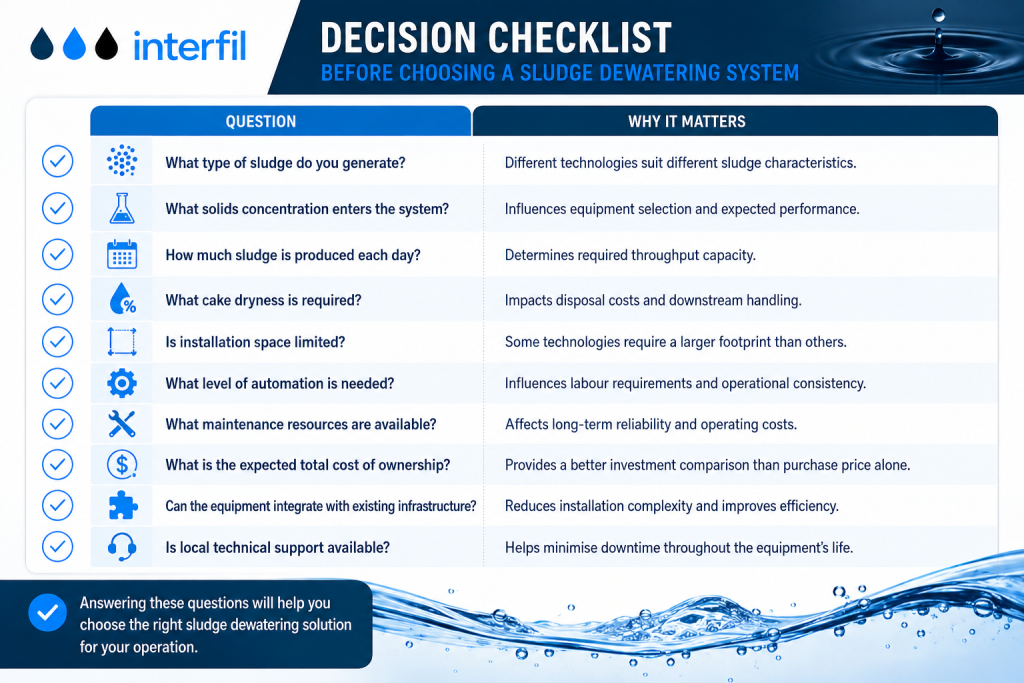
Key questions and considerations to assess before selecting the right sludge dewatering system for an industrial operation.
Answering these questions before requesting quotations helps narrow suitable technologies and supports a more informed purchasing decision.
Frequently Asked Questions
What is sludge dewatering?
Sludge dewatering is the process of mechanically separating water from sludge to reduce its weight and volume. This improves handling, lowers disposal costs and allows water to be recovered for further treatment or reuse where appropriate.
Which industries use sludge dewatering systems?
Sludge dewatering systems are widely used across manufacturing, mining, food and beverage production, chemical processing, metal finishing, pulp and paper manufacturing, and municipal and industrial wastewater treatment facilities.
What is the difference between a centrifuge and a belt filter press?
A centrifuge uses centrifugal force to separate solids and liquids and is often selected where high throughput and a compact footprint are important. A belt filter press removes water by applying pressure between moving belts and is commonly used for biological sludge in continuous treatment applications.
How dry can sludge become after dewatering?
The achievable solids content depends on sludge characteristics, conditioning methods and the selected technology. Filter presses generally achieve the highest cake dryness, while centrifuges, screw presses and belt filter presses provide different performance depending on the application.
What factors have the greatest impact on dewatering performance?
Performance is influenced by sludge composition, solids concentration, polymer conditioning, equipment selection, operating parameters, maintenance practices and process optimisation. Understanding sludge characteristics before selecting equipment helps achieve more consistent results.
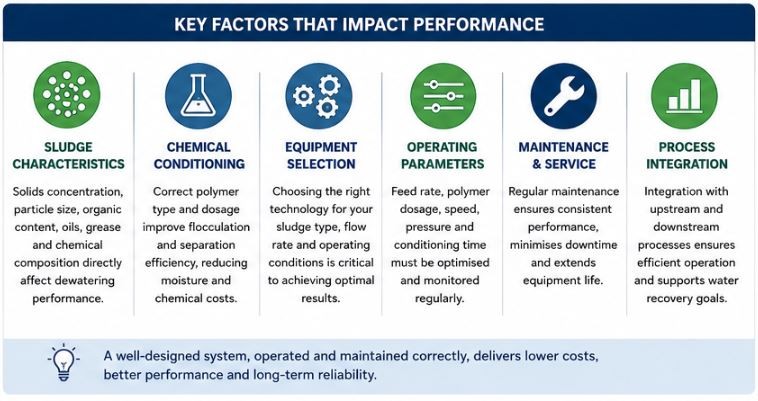
Sludge characteristics, equipment selection, operating conditions and maintenance all influence the efficiency and reliability of industrial sludge dewatering.
Conclusion
Choosing the right sludge dewatering systems starts with understanding your sludge characteristics, operational requirements and long-term costs. Factors such as throughput, cake dryness, maintenance, automation and system integration all influence performance and overall value. By evaluating these considerations before investing, industrial facilities can reduce disposal costs, improve operational efficiency and support more effective wastewater management with a solution tailored to their application.